
Gwirio Gwirio
Trust Infrastructure BOK

What Is Trust Infrastructure?

Trust Infrastructure is the infrastructure required to establish, verify, govern and exchange trusted digital claims and outcomes between organisations, individuals and systems.

Trust Infrastructure brings together Trust Authorities, trust controls, verification mechanisms, governance and decision-support capabilities to enable participants in a digital ecosystem to establish and rely upon trusted outcomes.
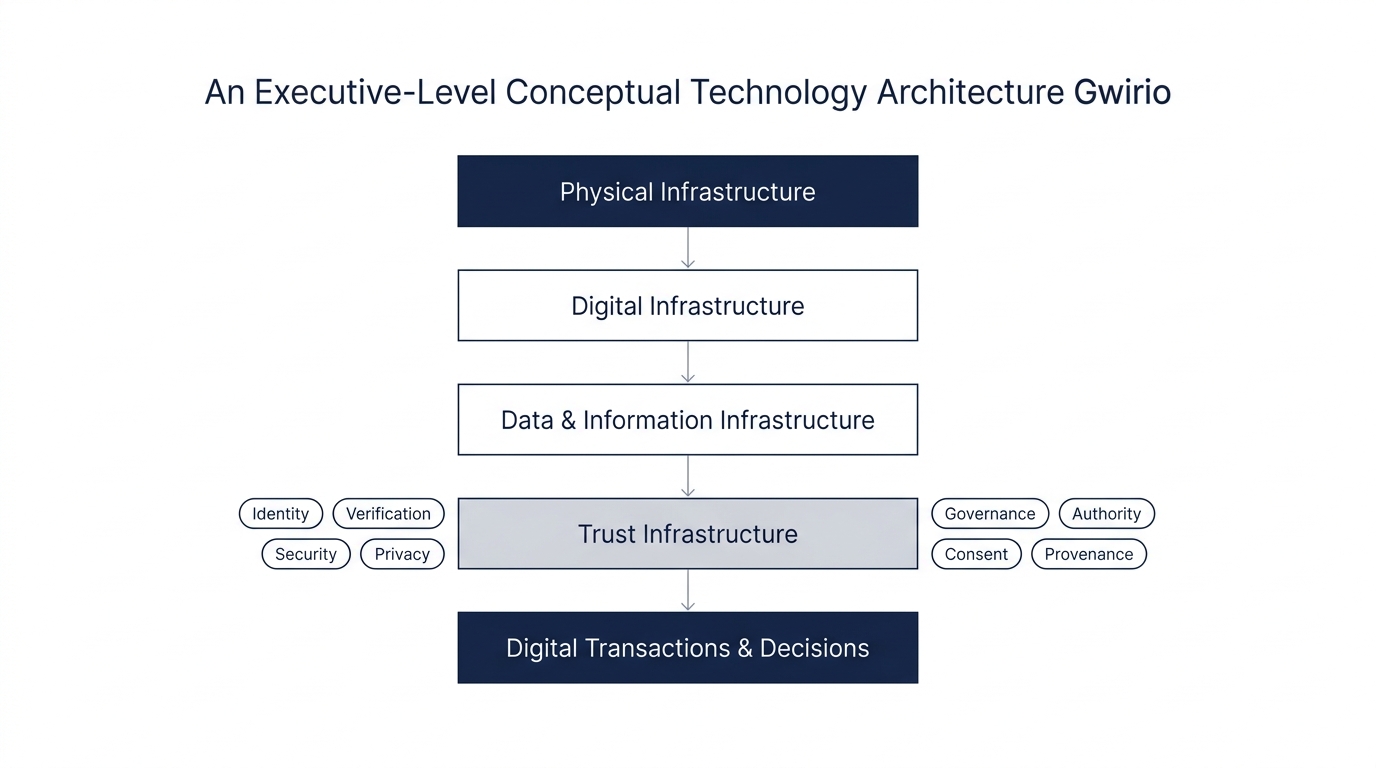
Diagram showing Trust Infrastructure as a layer built on Physical Infrastructure, Digital Infrastructure and Data & Information Infrastructure, supporting Digital Transactions & Decisions, drawing on Identity, Verification, Security, Privacy, Governance, Authority, Consent and Provenance.
Trust Infrastructure builds upon existing capabilities such as identity, security, privacy, verification, governance and authoritative information, bringing them together to enable trusted digital interactions and decisions.

What Is Trust?

Trust is the ability to rely on a digital claim of identity, authority, consent or legitimacy within a defined context.

Trust is contextual. A claim may be valid in one context, for one purpose, for a defined period, and under specific governance conditions — and not valid outside those bounds. A verified phone number is a reliable basis for one decision and not necessarily sufficient for another; a consent given for one purpose does not extend to a different one. Trust Infrastructure is what makes that context explicit and checkable, rather than assumed.

What Does Trust Infrastructure Do?

Trust Infrastructure performs five core functions:

Establish

Enables authoritative organisations to establish trusted claims about identity, authority, consent, legitimacy and other defined attributes.

Verify

Provides mechanisms to validate claims, evidence, provenance, validity and context.

Govern

Provides controls for managing the purpose, scope, validity, accountability, visibility and lifecycle of trust.

Exchange

Allows trusted claims and outcomes to be relied upon across organisational and system boundaries without requiring unnecessary exchange of the underlying information.

Decide

Enables trusted outcomes to support human and automated decisions.

Trust Infrastructure Capabilities

Trust Infrastructure is implemented through a set of capabilities that allow trust to be established, evidenced, governed and consumed. These are the current Gwirio capability model — not an exhaustive list of every possible Trust Infrastructure capability.

Trust Certificates

Structured representations of trusted claims, their provenance, validity and governing context.

Trust Assertions

Authoritative claims that can be relied upon within a defined context.

Consent Evidence

Evidence that consent has been obtained, including its scope, purpose, validity and status.

Audit Evidence

Evidence of how trust-related activities, claims and decisions were established and used.

Privacy-Preserving Verification

Verification mechanisms that establish the required trusted outcome without unnecessarily disclosing underlying information.

Data Subject Visibility

Capabilities that allow individuals to understand how their information, consent and trust relationships are being used and governed.

Trust Outcome Reporting

The production and communication of trusted outcomes that can be consumed by authorised parties and systems.

What Trust Infrastructure Is Not

Gwirio Trust Infrastructure is:

  • Not another identity platform.
  • Not another data broker.
  • Not a central database of trust.
  • Not a regulatory requirement.
  • Not a replacement for existing identity, security, privacy or data infrastructure.

Gwirio's objective is not to centralise trust or information. It is to provide the infrastructure through which trust can be established, verified, governed and exchanged across digital interactions.

Trust should be exchangeable without requiring unnecessary exchange of information.

A Trust Consumer does not necessarily need access to the underlying information used to establish a trusted claim. In many cases, it needs a reliable outcome that answers the decision it must make.

Individuals in the Trust Equation

Individuals should not disappear from the trust equation.

Trust Infrastructure should support:

  • Transparency
  • Accountability
  • Visibility
  • Appropriate consent
  • Understanding of how trust is created and used
  • Governance of trust relationships

This connects directly to Data Subject Visibility among the capabilities above — the mechanism through which that transparency and understanding is actually delivered to the individual. Individuals are not only data subjects within this model. They may also be participants and Trust Consumers within digital trust relationships.

Related

Continue reading

The Trust Gap → Gwirio Trust Framework → Trust Authorities → Trust Assertions → Trust Outcomes → Trust Decision Engine → Identity vs Trust → Privacy and Trust Infrastructure →