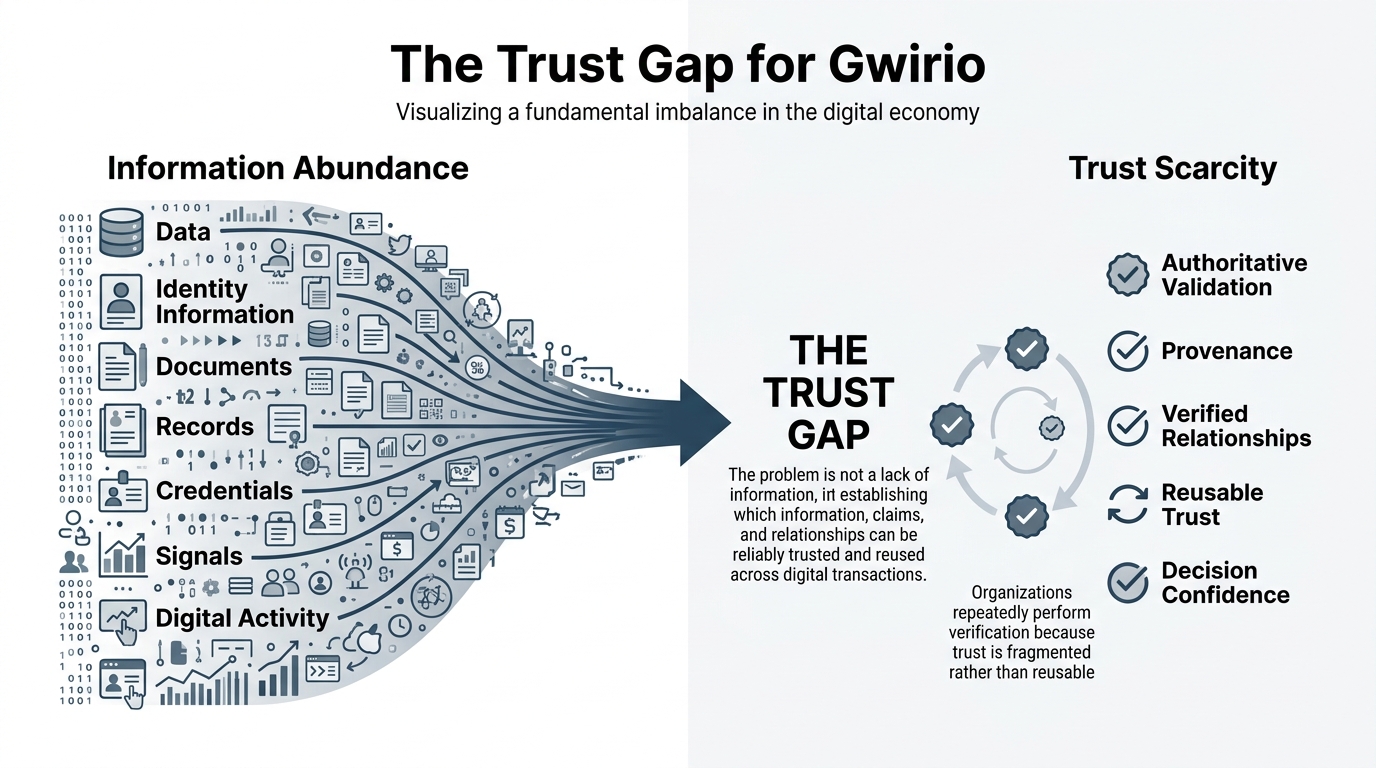
We have solved the problem of creating data. We have not solved the problem of
creating trust. A document can arrive over an encrypted connection, from a sender
authenticated with multi-factor authentication, with the attachment scanned for
malware — every security control can pass, and the document can still be false.
Security protects the channel. Identity proves who is participating. Neither answers
the question that matters: can I rely on this information?
Verification is fragmented
So every organisation fills the gap itself. Someone checks the document. Someone
phones the sender. Someone searches another database. Someone asks for another copy.
The same claim gets independently verified by every organisation that receives it
— five organisations, five investigations, five sets of evidence, five separate
trust decisions, none of them reusable.
The pattern repeats across ordinary business processes. Every bank performs its own
KYC checks. Every supplier onboarding process repeats due diligence another
organisation may have completed only weeks before. Every insurer performs its own
risk assessment. Every consent record sits in a database only its owner can rely on.
Every organisation develops its own interpretation of the same regulations.
Trust is established locally rather than reused
This is not simply inefficiency at the margins. It is the same trust decision being
made thousands of times over. Every duplicated trust decision increases cost, delays
transactions and creates new opportunities for fraud — shared trust is an
economic improvement, not just a security one.
Why this is the gap Trust Infrastructure closes
Information is not the constraint. The organisations described above are not short
of data — they are short of a way to reuse trust that another organisation has
already established. That is the specific gap Trust Infrastructure is built to close:
not by producing more information, but by letting a trusted outcome, established once
by an authoritative source, be relied upon across organisational boundaries instead of
being independently rebuilt every time. See
What Is Trust Infrastructure? for how
that capability is structured.