
Gwirio Gwirio
Gwirio Trust Framework

Trust Assertions

A Trust Assertion is more than a claim. It carries the context required to determine whether that claim can be relied upon.

A validated claim originating from an authoritative source and carrying sufficient context to determine whether it can be relied upon. A Trust Assertion is not simply a digital identity credential — an identity credential answers who someone is; a Trust Assertion carries the fuller context needed to decide whether a specific claim, in a specific context, can be relied upon.
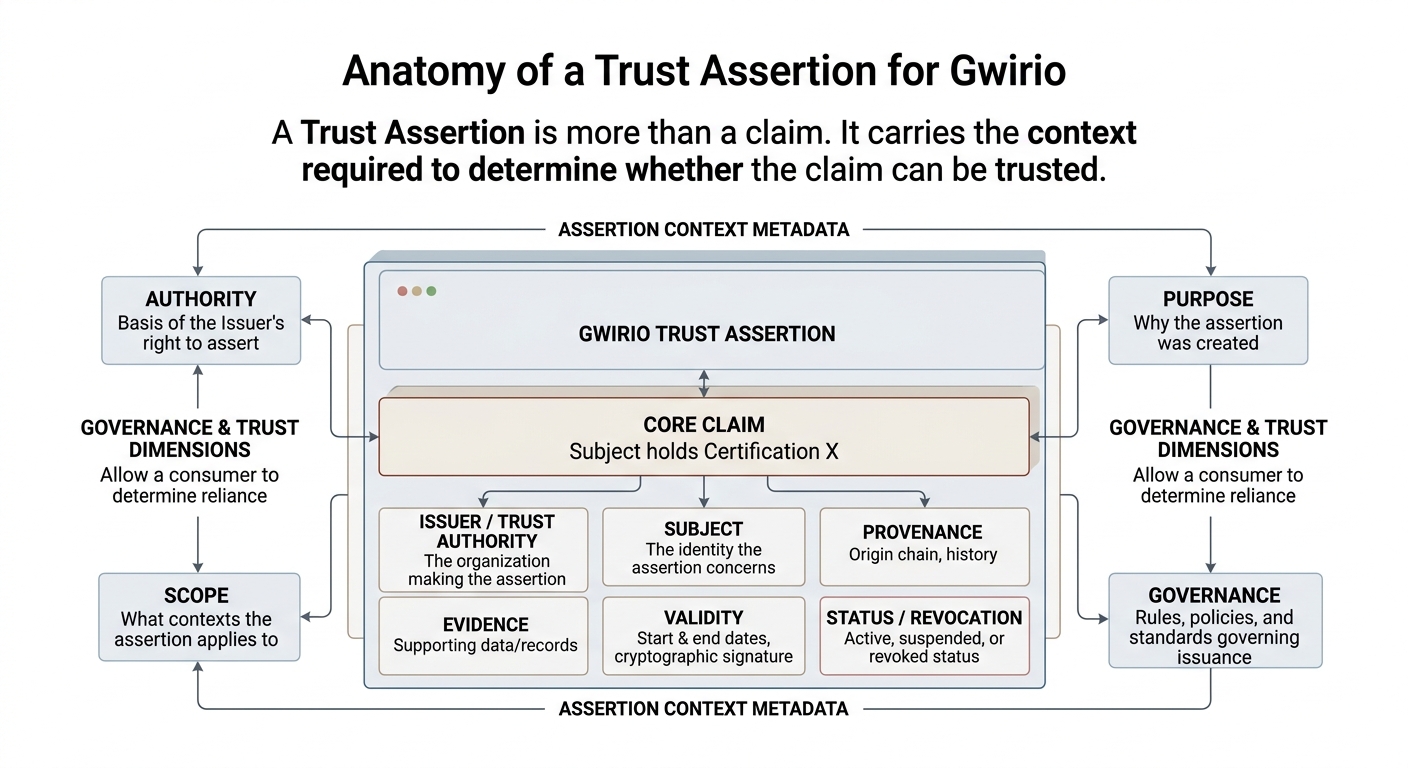
Diagram showing the anatomy of a Gwirio Trust Assertion: a core claim surrounded by Issuer/Trust Authority, Subject, Provenance, Evidence, Validity, Status/Revocation, Authority, Purpose, Scope and Governance.
Issuer / Trust Authority

The organisation making the assertion.

Subject

The identity the assertion concerns.

Claim

The specific fact being asserted — e.g. "Subject holds Certification X."

Evidence

The supporting data or records behind the claim.

Provenance

The origin chain and history of the claim.

Authority

The basis of the issuer's right to assert this claim.

Purpose

Why the assertion was created.

Scope

What contexts the assertion applies to.

Validity

Start and end dates, and the cryptographic signature confirming integrity.

Status / Revocation

Whether the assertion is active, suspended or revoked.

Governance

The rules, policies and standards governing issuance.

Together, these elements are what let a Trust Consumer evaluate an assertion on its own terms — without needing a separate relationship with the issuer, and without needing the underlying information the assertion is based on. Removing any one of them (authority, scope or validity, for example) turns the assertion back into an unverifiable claim.

Related

Continue reading

Trust Authorities → Trust Outcomes → Trust Certificates → What Is Trust Infrastructure? →