
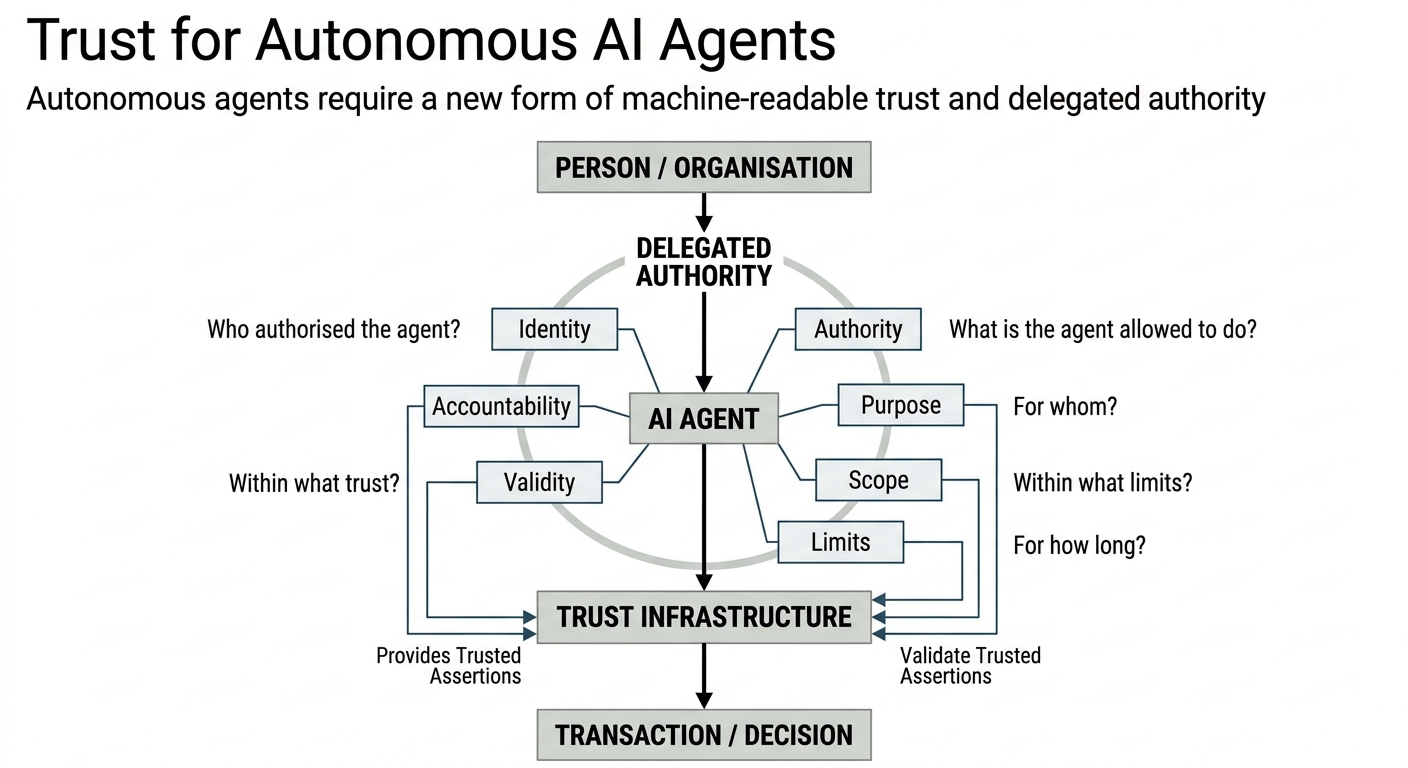
As AI systems begin acting on behalf of organisations — making recommendations, approving requests, initiating transactions — the question of where their authority comes from becomes as important as the question of their identity. Authority should never be assumed. It should be established before it is exercised, whether the actor is a person, an organisation, an API, or an AI system.
What has to be answerable
Digital systems have become good at authenticating identity. They are, in general, far less developed at governing authority: who delegated it, for what purpose, for how long, and whether it can be withdrawn. Those questions apply as much to a delegated AI agent as to a person acting under a power of attorney — the delegation has to be explicit, scoped, and revocable, not implied by the fact that the agent has access to a system.
Purpose and authority, not just consent
This connects directly to the sequence set out in Consent and Trust: authority, purpose and lawful basis need to be established before consent or action, not assumed by it. Information should only be used for the purpose for which authority was granted, and that authority should never extend beyond that purpose — a constraint that applies whether the actor exercising the authority is a person or a delegated AI agent.
Why this matters for governance
When authority is established before an AI system is allowed to process information or act, privacy and trust become more than a compliance checkbox — they become governance. See Machine Authority for what the delegated agent itself needs to be able to demonstrate once it holds that authority.